There are more places selling enamel pins than ever, and most of them are perfectly fine. The trouble is that "best" depends on what you're actually after — a souvenir, a piece of art, a gift, or something that will survive ten years on a jacket. Those are four different purchases.
We make pins, so take the following with the appropriate salt. But we'd rather tell you where not to buy from us than have you find out after the third disappointing order.
If a pin was made for a place, buy it at that place. The exhibition shop, the venue merch table, the small museum with the till by the door. If a designer drew it, buy it from the designer.
The reason is not snobbery. It's that a pin's value is almost entirely the story attached to it, and the story is easiest to keep when you were there. A pin you bought at the gig reminds you of the gig. The same pin bought secondhand from a reseller reminds you of a parcel.
Everything else below is a fallback for when that's not possible.
1. Buy it where you went.
Museum shops, gallery shops, venue merch tables, the odd National Trust property with a good buyer. Provenance is unbeatable, and the designs are usually better than you'd expect because someone was paid to care.
The catch: range is tiny, opening hours are a nuisance, and prices are set for a captive audience. You will occasionally pay more than the pin is "worth" in materials. You're paying for the fact that you were in the room.
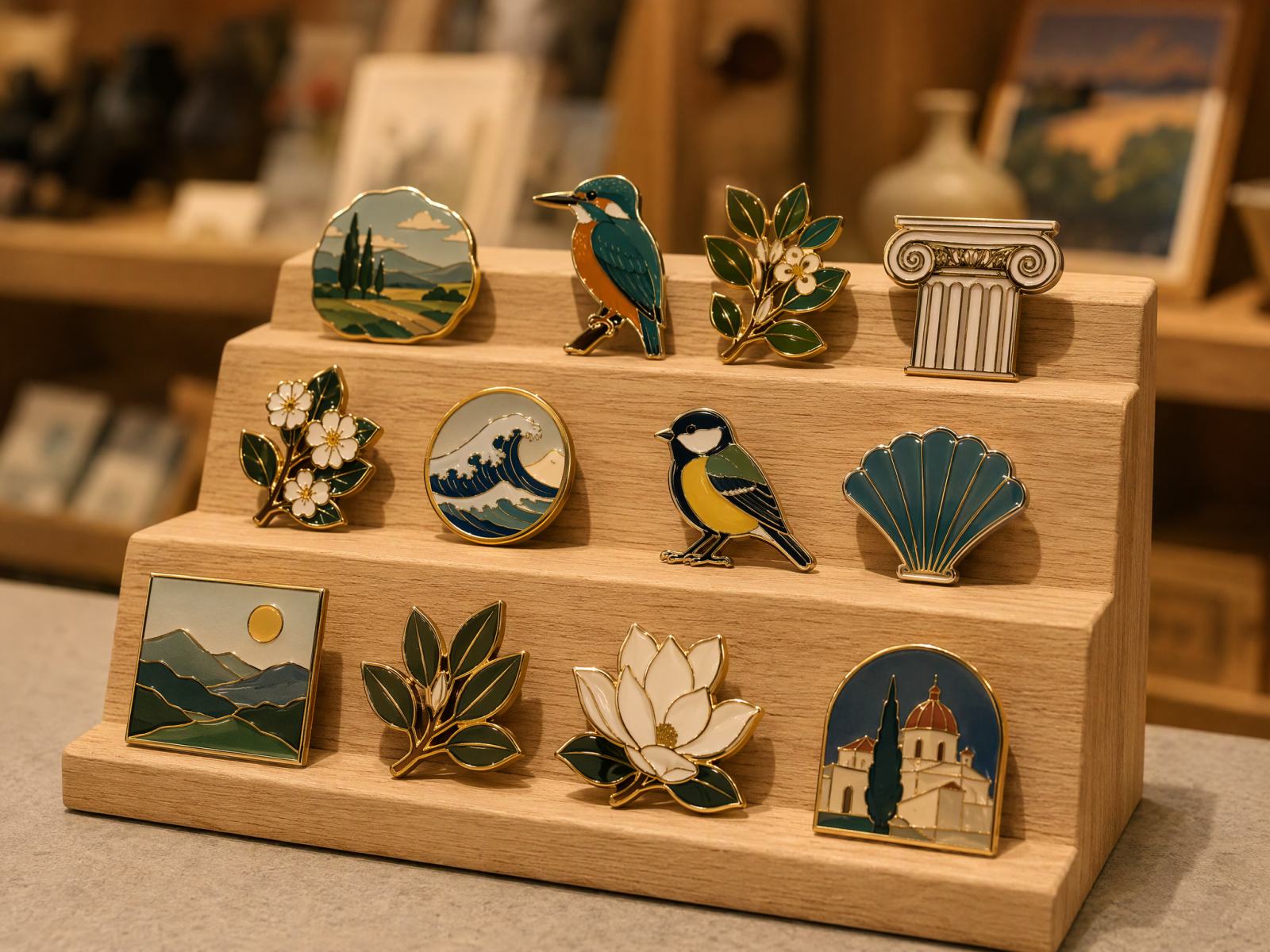
2. Buy it from the artist, directly.
Most independent pin designers sell through their own small shop, and many do the convention circuit. This is where the best designs live, because nobody approved them in a meeting.
Buying direct also means you can ask questions — what the plating is, whether it's hard enamel, when it ships — and get a real answer. At a convention you can hold the pin before you commit, which is worth more than any product photo.
The catch: small operations run on pre-orders, and a pre-order can take months. That's usually a cash-flow reality rather than a scam, but you should know what you're agreeing to.
3. Buy it from a marketplace — carefully.
Etsy, and the pin sections of the larger platforms, have the widest range by a distance. They also have the widest range of quality, from genuinely lovely to a pin that arrives with the plating already flaking.
Nothing wrong with buying here. Just do the checks in the next section, and be sceptical of a listing with one photo, no dimensions, and a price that seems too good.
4. Buy it from a pin shop.
There are specialist retailers who curate pins from many designers, plus a growing number of small physical shops. You pay a little more than buying direct, and in exchange you get one order, one shipping fee, and someone else having done the filtering.
This is the right choice when you're buying several pins at once, or buying a gift for someone whose taste you only half know.
5. Chase the drops.
The collectible end of the hobby runs on limited runs that sell out in minutes. You'll find them through designer newsletters, pin communities, and convention exclusive lists.
It's genuinely fun, and it's also where people spend the most money on things they didn't plan to buy. If you go down this road, set a rule before you start — one pin per drop, or a monthly budget — because "it'll never be reprinted" is a very effective sales pitch.
This list is boring and it will save you money.
The size, in millimetres. Not "medium". A 20mm pin and a 45mm pin look almost identical in a photo and are completely different objects on a jacket. If the listing doesn't say, ask.
Hard or soft enamel, stated. Soft enamel has the colour slightly recessed and you can feel the metal lines; hard enamel is polished flat and smooth. Neither is better, but they feel different and they're priced differently. A listing that can't tell you which one it is hasn't thought about it.
The plating, named. Gold, silver, nickel, black nickel, antique. It decides how the pin ages. Nickel dulls fastest with handling.
A photograph of the back. One clear shot of the reverse tells you more about manufacturing quality than five shots of the front. You want a straight centred post, a clean plated back, and a clutch that isn't obviously the cheapest one available.
In stock, or pre-order? This is the single biggest source of disappointment in the hobby. "Pre-order" can mean six weeks or six months. Check the date, and check whether the shop has delivered on previous pre-orders.
Reviews that mention wear, not just delight. "So cute!" tells you nothing. "Wore it daily for a year, still fine" tells you everything.
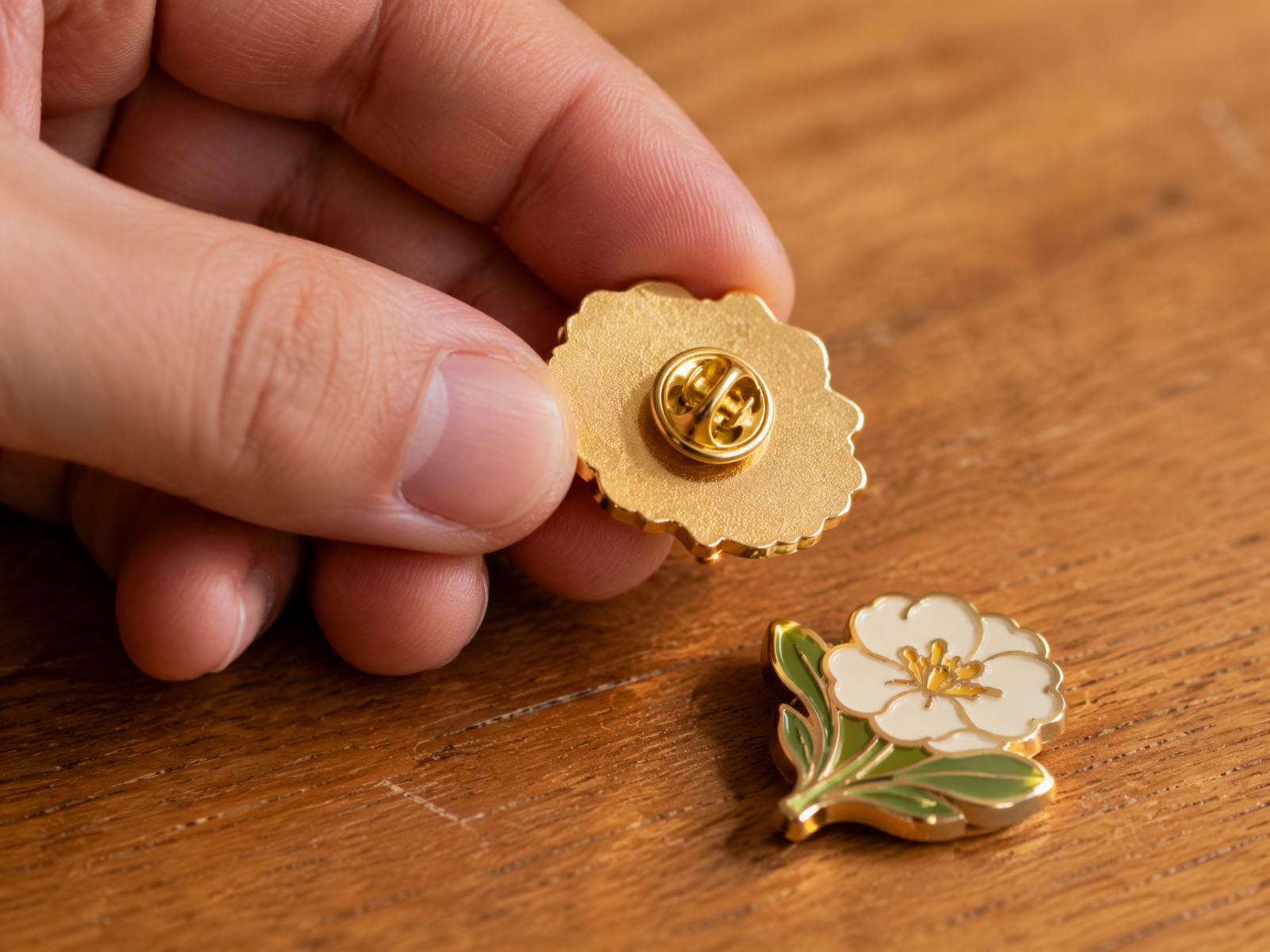
Four things, in about fifteen seconds.
Run your thumb across the surface. If you can feel ridges, it's soft enamel. Smooth means hard enamel. Neither is a fault; you just want to know what you paid for.
Look at the edge. You should see metal thickness, not a printed sticker on a blank. A crisp plated rim is a good sign.
Check the metal lines. They should be clean and even. If they're blobby or the colours bleed over them, the filling was rushed.
Spin the clutch. It should grip and hold. If it slides off with no resistance, plan to replace it — a bag of rubber backs costs almost nothing and solves it.
Not the metal. Zinc alloy is cheap, and so is the plating.
A pin's price is mostly the design, the die that had to be cut to make it, how many colours it uses, how many pieces were run, and how much the seller needs to charge to stay open. That's why two pins the same size can differ by a factor of four and neither seller is ripping you off. One is a 3,000-piece run of a design that took a week; the other is a 100-piece run by one person who drew it themselves.
We wrote the long version of this in our breakdown of pin pricing if you want the details.
Three practical notes.
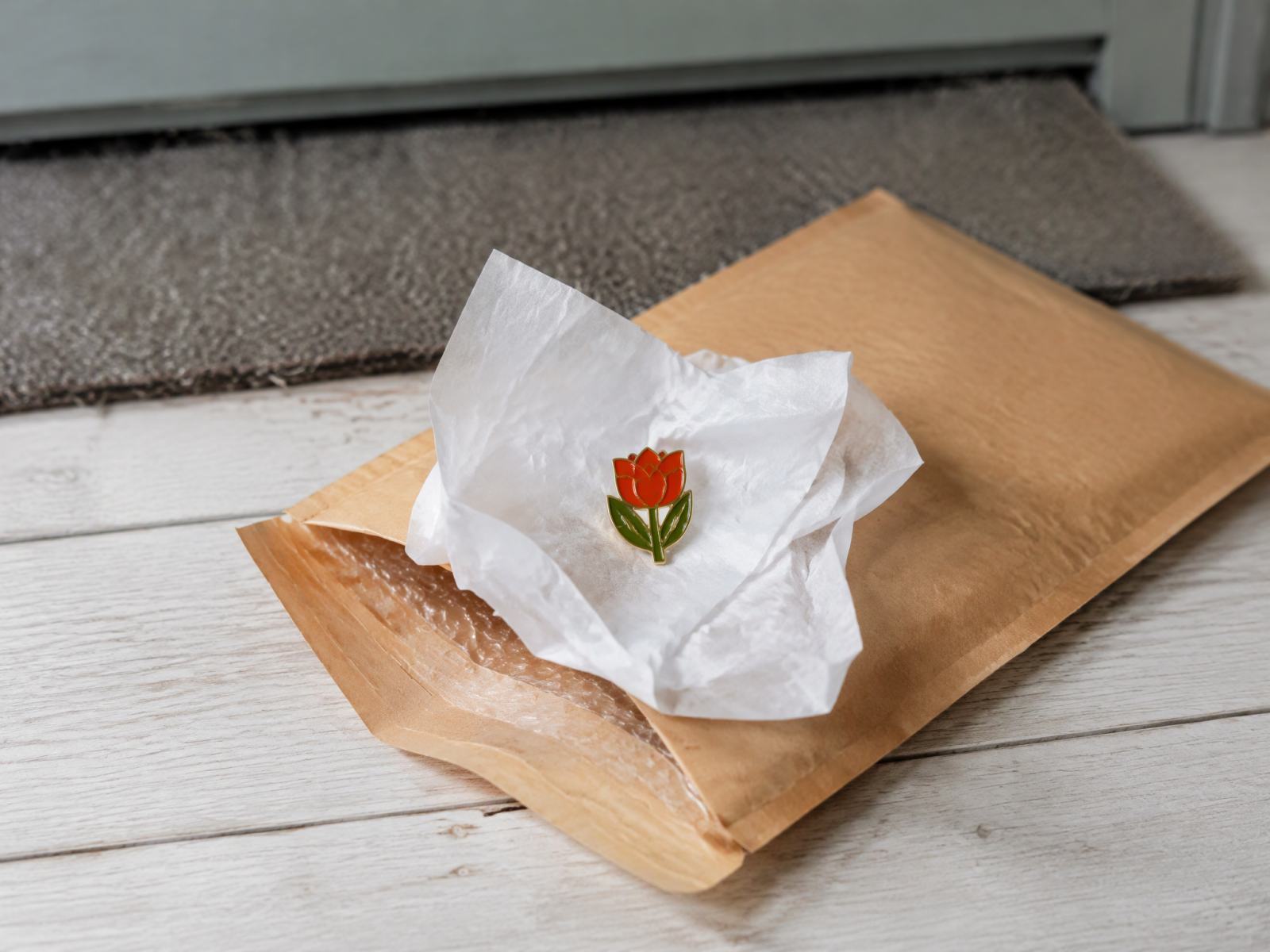
Buy two. This is what collectors actually do — one to give, one to keep. It also means you can open the parcel and check the pin before you hand it over, which matters if you're giving it to someone who'll notice.
Check the shipping time against the date, not against the estimate. A pin that ships from overseas in "7–10 business days" is not arriving before a birthday three days away.
Avoid pre-orders for gifts, always. There is no version of that story that ends well.
Sooner or later you'll want a specific design and nobody sells it. That's a different kind of purchase, and worth being clear-eyed about: custom pins are made in runs, so the economics only work if you want a hundred or more.
On the soft enamel side our runs start at 1,000 pieces, samples take about 5–7 days, and production is roughly 12–15 business days after artwork approval. If you're ordering for a club, a shop, a wedding or a band, that's the route — you can see the finishes on our enamel pins, compare printed colour on acrylic pins, and read the spec list on the custom soft enamel pin page. We'll send a free digital mockup before anything is cut.
If you want one pin for yourself, though, the honest answer is: don't order custom. Buy from a designer whose work you like, and put the money towards something they already made.
Buy it where the design came from, if you can. If you can't, buy it from the person who made it. If you can't do that either, buy from a shop you trust and check the back before you pay.
And whatever you do, stop buying pins because they're cheap. That's how the drawer happens — forty pins, none of them worn, and no memory attached to any of them. Ten pins you actually chose will beat forty you didn't.
It varies enormously, because the sellers vary enormously — some are designers running their own small production, some are resellers. Quality itself is usually fine; the real risks are vague listings, long pre-orders, and designs that were never checked for how they'd look at 25mm.
Sometimes slightly, since there's no shipping, but the real advantage isn't price. It's that you can hold the pin, see the actual size, and talk to the person who designed it. Convention exclusive designs also hold their value better.
Look for the word in the listing. If it isn't there, ask — a seller who makes the pins will know instantly. Be mildly suspicious of a listing that describes it as "premium enamel", which is not a term that means anything.
As objects, a limited run is no better than an open one. As collectibles, small runs hold value because they're hard to find later. Buy it if you like it. Don't buy it as an investment — the resale market for pins is thin and unpredictable.
Not economically. The die has to be cut regardless of how many pins you want, so a single pin ends up costing more than a run of several hundred. If you want one, buy an existing design instead.
