The first time you ask a factory about custom pins, the quote looks like a typing error. A thousand pins for a little over a thousand dollars. Then you ask what ten would cost, and the number barely moves.
That's the whole answer in one line: making a pin is cheap. Starting to make pins is what costs money.
At a thousand pieces, a one-and-a-quarter inch soft enamel pin costs roughly $1.23 each. At five thousand it's about $0.85. Those are prices from published manufacturer price sheets, not marketing.
At ten pieces, the same pin can come out at $5 to $7 each — and that's before the die, which is the one cost that never shrinks no matter how small your order is.
So: no, it is not expensive to make an enamel pin. It is expensive to make your enamel pin in small numbers, because you're paying for the setup of a small factory run and then dividing that bill among a handful of pins.
Five things happen between your design and a pin in a bag.
Someone cuts a die. A block of steel gets your exact outline and every colour cell engraved into it. This is the expensive, slow, skilled part, and it happens once.
The metal gets stamped. A sheet of brass is pressed into that die, and the shape pops out with your design in relief. The blank weighs a few grams. As raw material it is worth less than the card it will be mounted on.
It goes into a plating bath. Gold, silver, nickel, black nickel, copper. Standard finishes cost nothing extra; they're part of the per-piece price.
Colours get filled by hand. This is the part people don't expect. One colour, one pass, one person with a fine tool. A seven-colour pin has been handled seven times. That's why colour count has a price and why a simple two-colour design is genuinely cheaper to make, not just easier to draw.
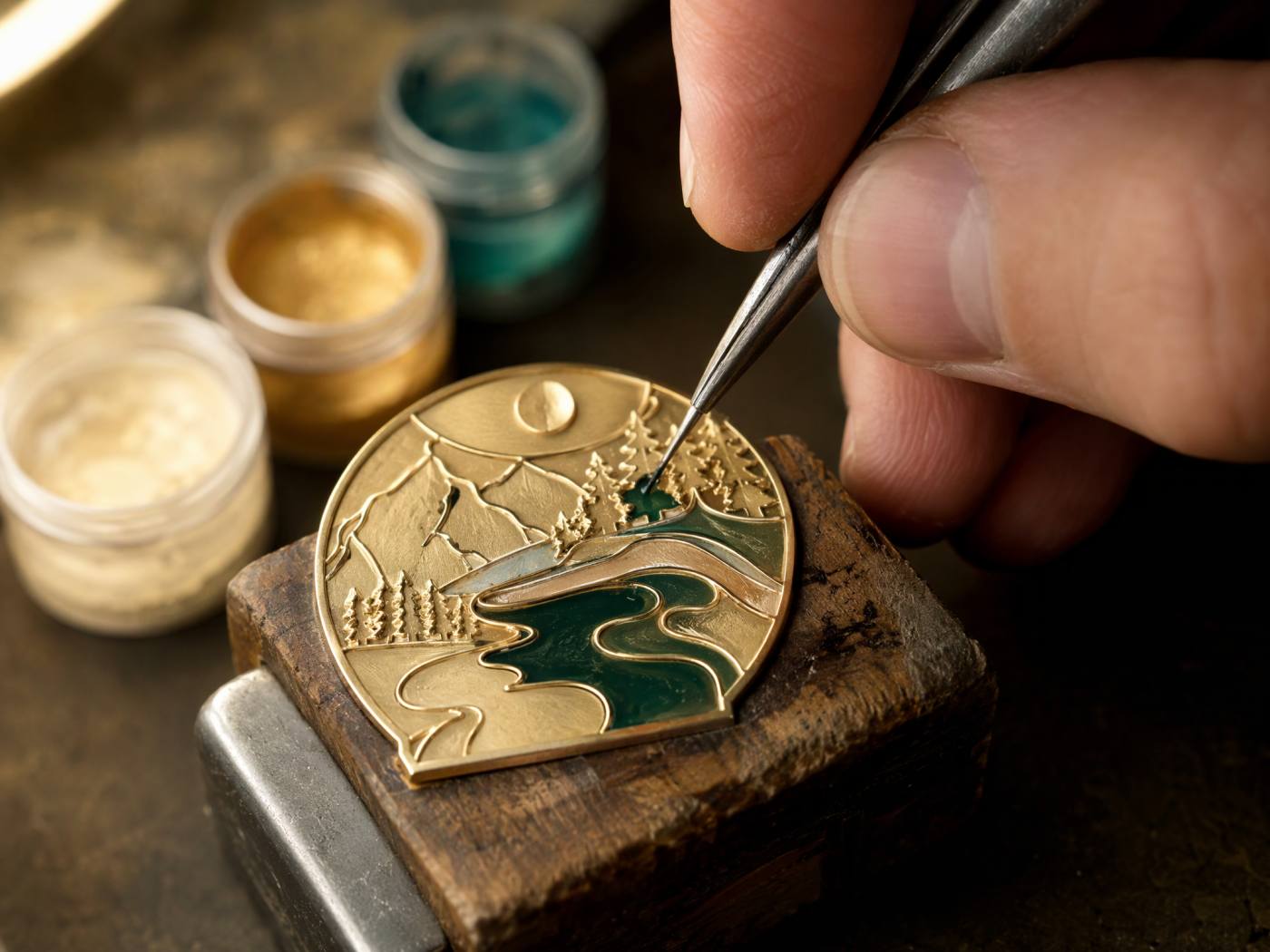
If it's hard enamel, it gets sanded flat. Then polished, which is another step, another set of hands, and another chance to ruin a batch. Then the post is soldered, the clutch goes on, and someone cards it.
None of those steps is dramatic. Together they explain why a pin costs a dollar and not five cents.
The die is a one-time cost, usually somewhere between $50 and $150 depending on the size and how intricate the outline is. It gets stored for you (often for a couple of years), so reordering the same design doesn't pay for it twice.
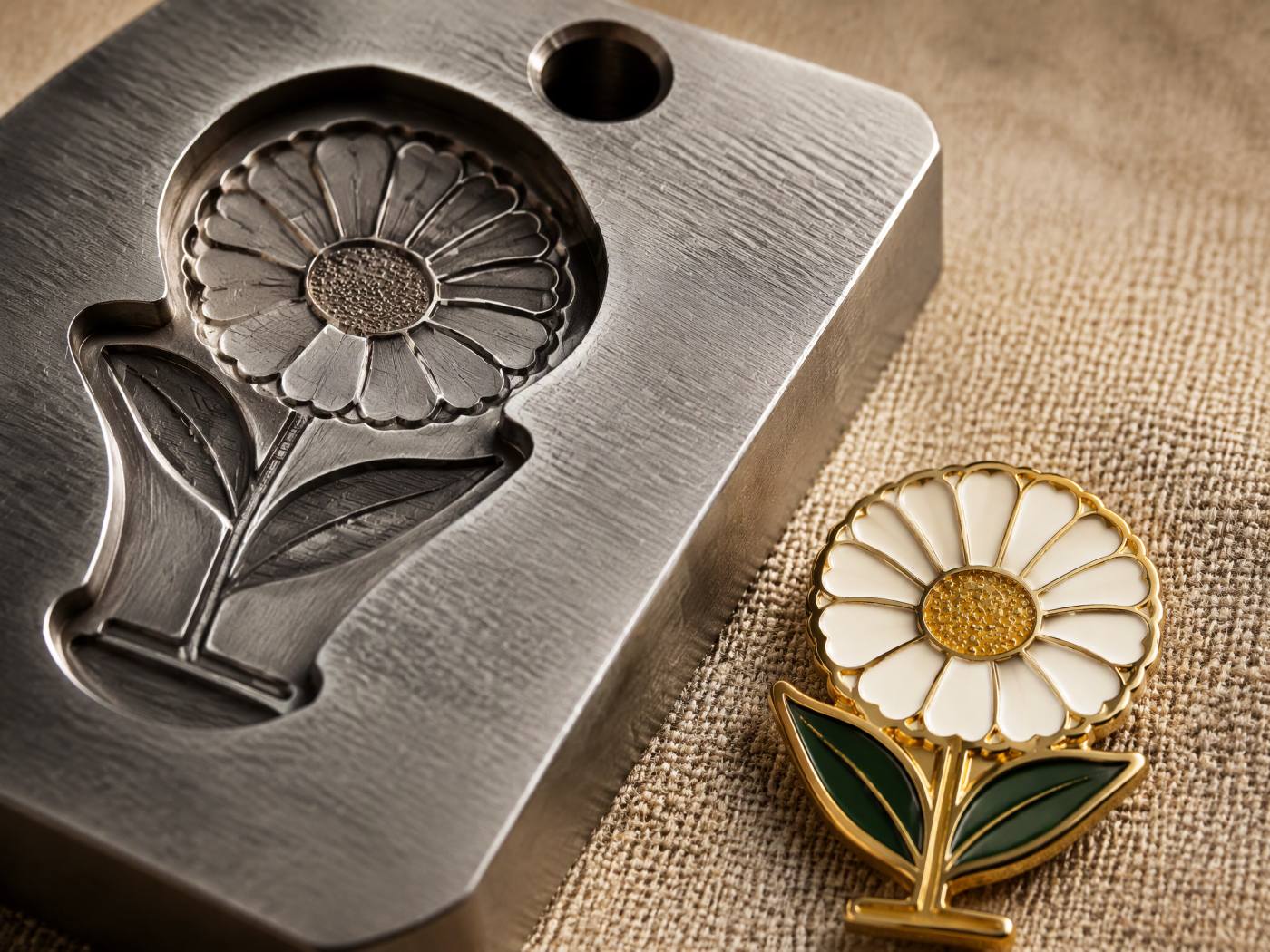
It also does not care how many pins you want. That's the entire mechanic.
This is why "no mold fee" is never really free. A die always has to be made. A factory advertising no setup charge has simply folded that cost into the per-piece price. The total for a small order usually lands in the same place — it just looks friendlier on the page.
A practical consequence: if you're ordering a hundred pins and the supplier waives the die, compare the total, not the line items. A $0 die at $3.50 a pin is a worse deal than a $100 die at $2.60.
Published price sheets for a one-and-a-quarter inch soft enamel pin, same design, same die:
The pin doesn't get cheaper to make. The fixed costs just get spread thinner. Roughly, doubling an order can knock 25 to 40 per cent off the unit price, which is a strange thing to experience the first time: you ask for more and the price per pin drops by a third.
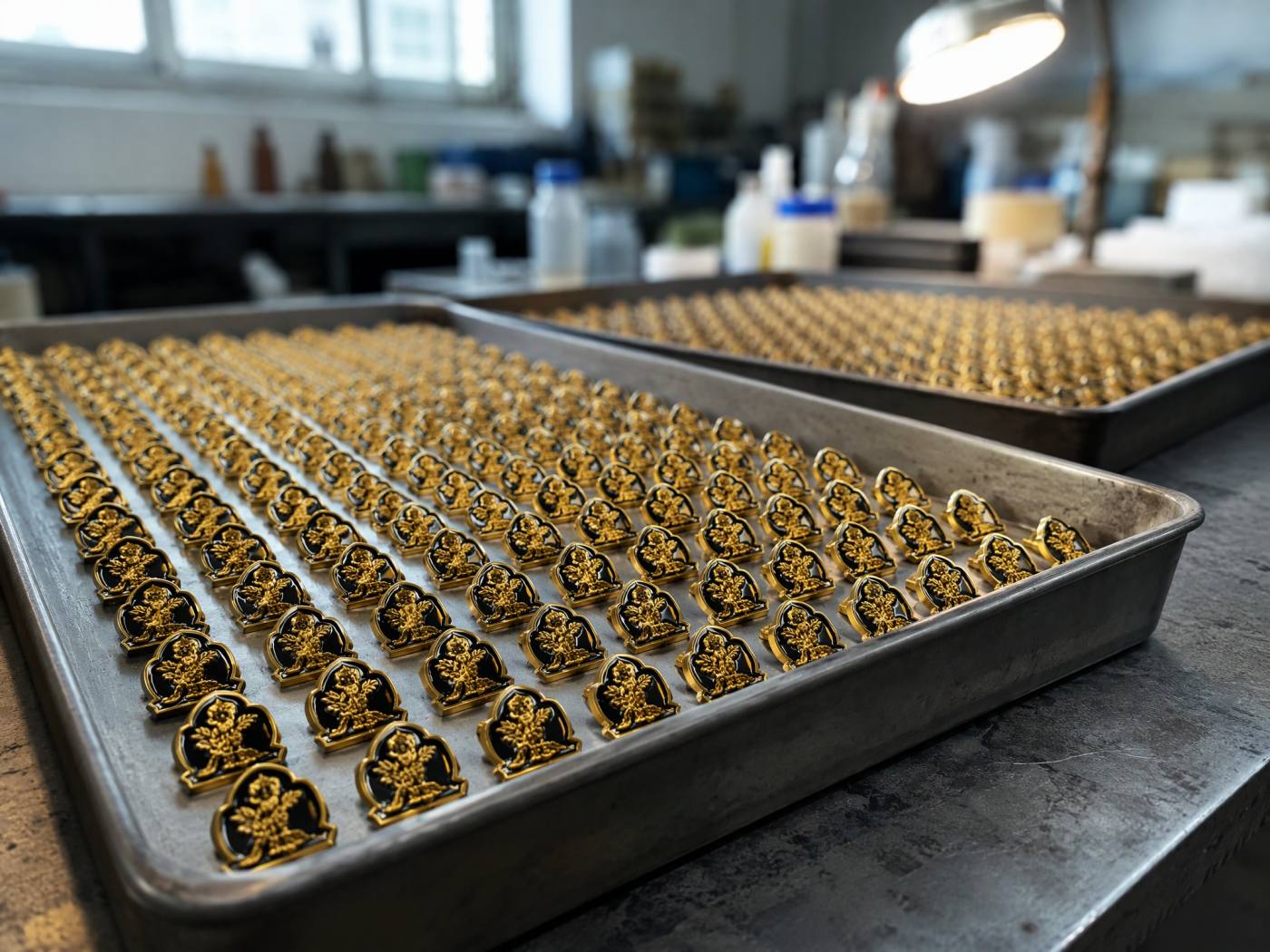
The corollary is the useful part. If you think you might need two hundred pins, order two hundred now. Two orders of a hundred almost always cost more than one order of two hundred, and the second order also pays for freight twice.
One pin, for yourself. You'd pay the die plus a per-piece rate, so realistically $60 to $160 for a single pin, depending on the die and who's willing to run it. That's not a scam, it's arithmetic. Buy an existing design you like, or make a craft version at the kitchen table and accept that it isn't enamel.
Fifty pins, for a club or a small event. Assume around $100 for the die and a bit over $3 each for the pins, since fifty sits below the hundred-piece tier. That lands near $260, or about $5 a pin. Fine if this is a keepsake people will keep on a jacket for years. Silly if it's a giveaway that ends up in a drawer.
Five hundred pins, for a small shop or a launch. The die at $100 and the pins at $1.44 comes to about $820 all in, which is $1.65 each. At this point making pins is genuinely cheap. What you're really paying for is the months those pins spend in a box before they sell.
Notice what changed between those three: not the pin, not the factory. Just how many people agreed to take one.
Every first-time order hits some version of these, so budget for them rather than being surprised.
Artwork. Most factories prepare a digital proof free and include a couple of revisions. What they need from you is a clean vector file. A photo or a screenshot has to be redrawn, and that's where "free artwork" quietly becomes a delay.
The sample. Ask two questions before you assume: is the physical sample free, and who pays the courier. Both vary.
Duty and tax on arrival. Pins are light, but they're not free to import, and the bill arrives after the pins do.
Packaging. Backing cards, bags, tissue, a sticker. At small volumes this can cost more per pin than the enamel does.
Storage and patience. A thousand pins is a shoebox that weighs a couple of kilos and takes months to sell. That's fine. It just means your money is sitting in a box for a while.
Production time. Samples typically take about a week; production runs several weeks after artwork approval. If your event is in three weeks, you're not ordering pins, you're hoping.
If the quote comes back higher than you expected, it's almost always one of these:
People ask some version of this every week: if the factory is charging a dollar a pin, why not make it myself?
Because the thing that makes an enamel pin an enamel pin is a steel die and a press, plus enamel that gets fired. The home versions — shrink plastic, UV resin in a bezel, painted laser-cut wood — can look lovely and are a genuinely nice craft project. They are also not enamel, and they won't feel like a coin in your hand.
So the honest framing isn't "factory versus kitchen table." It's "how many do I actually need." One or two, make something by hand and enjoy it. More than a hundred, the factory is cheaper than your own time.
Around $250 to $350 in total, including the one-time die. At that volume you're paying roughly $2.50 to $3.50 per pin, and a good part of that is still the setup being divided among a hundred pieces.
Typically $50 to $150, depending on size and outline complexity. It's charged once, stored for future reorders, and sometimes waived on larger orders — in which case check the per-piece price, because the cost didn't disappear.
Because the die is the same whether you make one pin or one thousand. You're not paying for a pin, you're paying for a production setup with a single customer.
If the pin will be worn regularly, yes — the polished flat surface resists scratching and dirt far better. If it's a display piece or a one-off gift, soft enamel looks great and costs noticeably less.
Many factories will run ten, and some won't. Either way the per-piece price at ten is several times the price at a thousand, so ask for the total before you decide. We don't set a minimum order ourselves, which is unusual — but no minimum doesn't make small runs cheap, and it's fairer to say so up front.
Making enamel pins is not expensive. It's a dollar or so a pin at volume, and the metal in your hand costs less than the paper it's pinned to.
What's expensive is being early. The die, the minimum, the setup, the sample, the weeks of production — that's the bill you pay for wanting a design that didn't exist before. Once a few hundred other people want it too, the maths turns in your favour quickly.
If that's where you are, our soft enamel page lists the sizes and finishes, and the finished pieces in the enamel pin collection show what the different builds actually look like in the hand. If you're still deciding whether a pin is worth ten dollars on a shop shelf, that's a different question, and we wrote about it separately.
